Table of Contents
| # | Topic |
|---|---|
| 1 | Optogenetics: How scientists used light to control brain cells (Nobel 2026) |
| 2 | India–Switzerland ties in defence and nuclear energy |
| 3 | Great Nicobar Project: SC rejects Centre’s objection to PIL in HC |
| 4 | West Bengal signs UDAN pact for 4 airports |
| 5 | Only 9% of workers use public transport to commute |
| 6 | Yemeni government forces drive Houthis from Bab el-Mandeb |
| 7 | Three High Court Chief Justices elevated to the Supreme Court |
| 8 | House privileges vs free speech before the Supreme Court |
| 9 | Why Buxa is bringing tigers back |
| 10 | Why states are divided over the mining amendment |
1. Optogenetics: How Scientists Used Light to Control Brain Cells
Syllabus: GS3 – Science & Technology (biotechnology, health)
Why in news: The 2026 Nobel Prize in Physiology or Medicine went to Karl Deisseroth (USA), Peter Hegemann and Georg Nagel (Germany), announced on 5 October 2026, for discoveries on light-gated ion channels that led to optogenetics.
What is optogenetics?
Optogenetics lets scientists switch individual nerve cells on or off in a living brain using flashes of light. It combines optics (light delivered through thin optical fibres) with genetics (inserting a gene for a light-sensitive protein into chosen neurons).
- Find the switch: A green alga, Chlamydomonas reinhardtii, swims towards light using an eyespot. Hegemann and Nagel found the protein behind this, channelrhodopsin – an ion channel that opens when struck by light.
- Insert the switch: Using a harmless virus, the gene for channelrhodopsin is delivered only into a selected type of neuron.
- Flip the switch: Blue light opens the channel, positive ions rush in and the neuron fires. Other proteins, such as halorhodopsin, respond to yellow light and silence neurons.
- Watch behaviour: Because the response takes milliseconds, researchers can link a specific cell type to a specific behaviour, memory or emotion.
Why it matters
- Brain mapping: Earlier tools – electrodes and drugs – could not target one cell type quickly and precisely. Optogenetics can.
- Medicine: It is used in research on Parkinson’s disease, depression, addiction, epilepsy and chronic pain. In 2021 it helped partly restore vision in a blind patient with retinitis pigmentosa.
- Limits: It needs gene delivery and light to reach deep tissue, so human therapy remains largely experimental; ethical questions on altering brain activity remain.
Key Facts for Prelims
| Fact | Detail |
|---|---|
| Laureates | Karl Deisseroth (Stanford University), Peter Hegemann (Humboldt University, Berlin), Georg Nagel (University of Würzburg) |
| Official citation | Discoveries concerning light-gated ion channels and optogenetics |
| Key protein | Channelrhodopsin (ChR1 described 2002, ChR2 in 2003) |
| Source organism | Green alga Chlamydomonas reinhardtii |
| First use in mammalian neurons | 2005, Deisseroth’s lab at Stanford |
| Term “optogenetics” | Coined in 2006 |
| Light used | Blue light activates ChR2; yellow light activates silencing proteins |
| Prize money 2026 | 12 million Swedish kronor per prize |
| Awarding body | Nobel Assembly at Karolinska Institutet, Stockholm |
2. India–Switzerland to Strengthen Ties in Defence and Nuclear Energy
Syllabus: GS2 – Bilateral relations; GS3 – Energy, Defence
Why in news: Swiss President Guy Parmelin began a three-day state visit to India on 5 October 2026 – his first state visit and second trip to India this year, after the AI Impact Summit in February. After talks, PM Narendra Modi said the two sides had identified new areas of cooperation in defence production, military exchanges and civil nuclear energy.
Outcomes of the visit
Five agreements were signed:
- A Migration and Mobility Partnership agreement, easing travel for students and professionals.
- A Young Professionals exchange scheme for short-term work experience.
- An agreement on transport technologies, mobility systems and infrastructure.
- Two other agreements (full list awaited from the MEA).
Both sides also agreed to widen Swiss market access for Indian exports. Switzerland pressed for an early Bilateral Investment Protection Agreement, since India’s earlier BIT with Switzerland lapsed in 2017. Ukraine and West Asia were also discussed.
Why it matters for India
- TEPA anniversary: The visit came a year after the India–EFTA Trade and Economic Partnership Agreement (TEPA) entered into force on 1 October 2025. EFTA has committed to USD 100 billion of investment and 1 million direct jobs in India over 15 years.
- Nuclear energy: Switzerland is a member of the Nuclear Suppliers Group (NSG) and backed India’s membership bid in 2016. Swiss precision engineering can support India’s target of 100 GW nuclear capacity by 2047 and the opening of the sector to private players.
- Defence: Swiss firms are strong in precision components, optics and drones – a fit for Make in India and defence exports.
- Neutrality and non-alignment: Swiss neutrality and India’s strategic autonomy give both a shared approach to the Ukraine and West Asia conflicts.
Key Facts for Prelims
| Fact | Detail |
|---|---|
| Swiss President (2026) | Guy Parmelin |
| Treaty of Friendship | Signed 14 August 1948, one of independent India’s first treaties |
| India–EFTA TEPA | Signed March 2024; in force from 1 October 2025 |
| EFTA members | Switzerland, Norway, Iceland, Liechtenstein |
| TEPA investment pledge | USD 100 billion and 1 million jobs over 15 years |
| Groupings both belong to | MTCR, Wassenaar Arrangement, Australia Group (India is not yet in the NSG) |
| Swiss capital / currency | Bern / Swiss franc (CHF) |
3. Great Nicobar Project: SC Dismisses Centre’s Objection to PIL Maintainability in HC
Syllabus: GS3 – Environment, Infrastructure; GS2 – Judiciary, Tribal rights
Why in news: On 5 October 2026, a Bench of CJI Surya Kant, Justice Joymalya Bagchi and Justice V. Mohana refused to entertain the Centre’s challenge to a Calcutta High Court order. The HC had held that PILs alleging violations of the Forest Rights Act, 2006 in the Great Nicobar project were maintainable. The HC will hear all connected petitions on 25–26 November 2026.
The case in brief
- Petitioner: Former bureaucrat Meena Gupta, who argued that tribal consent for diverting forest land was not obtained properly.
- Centre’s objection: She lacked locus standi as she lives in Hyderabad, not in the islands; the affected tribes were not before the court; and the environmental clearance was already being examined by the National Green Tribunal.
- Calcutta HC (6 May 2026): No rigid “thumb rule” on locus standi in PILs, especially where vulnerable communities are involved. A project’s cost or national importance does not place it beyond judicial review.
- Supreme Court: Kept open the questions of how much public interest is involved and the scope of the petitions, but let the HC proceed.
About the Great Nicobar Project
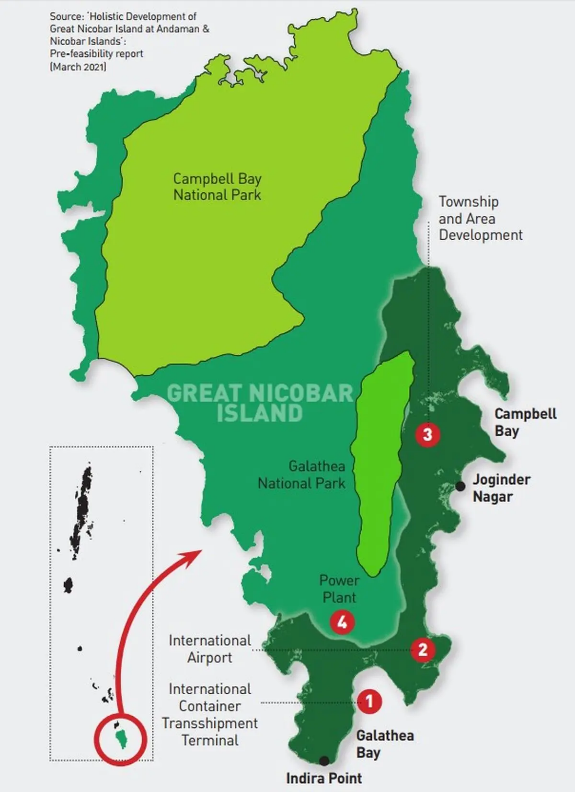
The ₹72,000-crore project by NITI Aayog and ANIIDCO has four parts: an International Container Transshipment Terminal at Galathea Bay, a greenfield international airport, a 450 MVA gas-and-solar power plant, and a township. It needs about 130 sq km of forest land.
| Strategic case | Ecological and social concerns |
|---|---|
| Close to the Malacca Strait, one of the world’s busiest shipping lanes | Felling of nearly 9–10 lakh trees in tropical rainforest |
| Ends dependence on Colombo, Singapore and Port Klang for transshipment | Galathea Bay is a nesting site of the Giant Leatherback turtle |
| Strengthens India’s presence in the Indian Ocean against China | Threat to Shompen (PVTG) and Nicobarese communities |
| Supports the Andaman and Nicobar Command | High seismic zone; the 2004 tsunami caused land subsidence |
Key Facts for Prelims
| Fact | Detail |
|---|---|
| Location | Southernmost island of the Andaman & Nicobar chain; Indira Point is India’s southernmost point |
| Protected areas | Campbell Bay National Park, Galathea National Park; Great Nicobar Biosphere Reserve (UNESCO MAB list, 2013) |
| PVTG | Shompen – semi-nomadic hunter-gatherers |
| Key species | Leatherback turtle, Nicobar megapode, Nicobar macaque |
| Forest Rights Act, 2006 | Requires Gram Sabha consent before forest land is diverted |
| Jurisdiction | Andaman & Nicobar Islands fall under the Calcutta High Court |
| Article 226 | High Courts’ writ jurisdiction – the basis of the PIL |
4. West Bengal Signs UDAN Pact for 4 Airports; CM Blames Delay on Previous TMC Government
Syllabus: GS3 – Infrastructure (airports); GS2 – Centre–State relations
Why in news: On 5 October 2026, West Bengal, the Ministry of Civil Aviation and the Airports Authority of India (AAI) signed an MoU at Nabanna to implement UDAN in the state. Four airports will come up at Chharra (Purulia), Balurghat (Dakshin Dinajpur), Hasimara (Alipurduar) and Kalaikunda (Paschim Medinipur) within about two years.
Key points
- Union Civil Aviation Minister K. Rammohan Naidu said the Centre would spend ₹29,000 crore under UDAN in Bengal over ten years, and asked the state to frame a civil aviation policy.
- CM Suvendu Adhikari said the earlier TMC government’s failure to hand over land had stalled these airports and a second Kolkata airport. He sought full airports at Malda and Cooch Behar.
- Hasimara and Kalaikunda are Indian Air Force bases, so civil flights will run from civil enclaves there.
- Challenge: Cooch Behar, revived under UDAN in 2023, now has no regular commercial flight – a sign that UDAN routes often fail once the subsidy period ends.
UDAN: how the scheme works
- Bidding: Airlines bid for unserved or under-served routes and quote the Viability Gap Funding (VGF) they need.
- Fare cap: About half the seats are sold at capped fares for flights of roughly one hour.
- Support: VGF is shared by the Centre (80%) and states (20%; 10% for North-East and UTs) for three years, plus cheaper fuel tax, free land and security from states.
- Exclusivity: The winning airline gets the route alone for three years.
Key Facts for Prelims
| Fact | Detail |
|---|---|
| Full form | Ude Desh ka Aam Nagrik |
| Launched | 21 October 2016 under the National Civil Aviation Policy, 2016; first flight April 2017 (Shimla–Delhi) |
| Nodal ministry / agency | Ministry of Civil Aviation / AAI as implementing agency |
| Funding | Regional Connectivity Fund via a levy on major-route flights |
| Extension | Modified UDAN extended for 10 years beyond 2026 (Union Budget 2025–26: 120 new destinations, 4 crore passengers) |
| Bengal’s new sites | Chharra, Balurghat, Hasimara, Kalaikunda |
| Related scheme | Krishi UDAN for farm produce; UDAN also covers helicopters and seaplanes |
5. Only 9% Use Public Transport to Go to Work: National Household Travel Survey
Syllabus: GS1 – Urbanisation; GS3 – Infrastructure, Environment
Why in news: The National Statistics Office (MoSPI) released the factsheet of India’s first-ever National Household Travel Survey (NHTS), conducted July 2025–June 2026, on 5 October 2026. A trip is counted only if it covers more than 1 km. The data shows personal two-wheelers dominate work travel, while buses, trains and metro together carry only around 9% of workers – the figure The Indian Express highlighted.
What the survey found
| Indicator | Finding |
|---|---|
| Workers travelling >1 km to work | 57.6% overall; 61.9% of men vs 41.9% of women |
| Two-wheeler share of work commutes | 52.3% urban, 37.1% rural |
| Rail-based modes (metro, suburban rail, monorail, tram) | 5% of urban work commutes; 20.7% in Maharashtra, 16.5% in West Bengal, 14.4% in Delhi |
| Average monthly commute cost | ₹785 (₹1,044 urban, ₹612 rural); men ₹835, women ₹533 |
| Average one-way time to fixed workplace | 25 minutes; 83.4% reach within 30 minutes |
| Students’ commute | 37% walk, 29.5% bus, 15.8% bicycle; ₹435 per month |
| Overnight household trips | Bus 55.8%, inter-city rail 17.7%, car 15.1%, two-wheeler 8.8% |
Why low public transport use is a problem
- Congestion and pollution: Two-wheelers and cars drive urban PM2.5 and transport-sector CO2 emissions, working against India’s net-zero 2070 goal.
- Bus shortage: India has far fewer buses per lakh people than the benchmark of about 60 suggested by MoHUA; most cities lack organised city bus services.
- Gender gap: Women travel shorter distances and spend less – unsafe or unaffordable transport limits their work participation.
- Last-mile gaps: Metros underperform ridership forecasts without feeder buses, walkable streets and integrated ticketing.
Government responses
- PM e-Bus Sewa (2023): 10,000 electric buses for cities under PPP.
- PM e-DRIVE (2024): Subsidy for e-buses, e-two-wheelers and charging.
- National Urban Transport Policy, 2006 (revised 2014) and Metro Rail Policy, 2017 – “move people, not vehicles”.
- National Common Mobility Card (One Nation One Card) for seamless fares.
Key Facts for Prelims
| Fact | Detail |
|---|---|
| Survey | National Household Travel Survey (NHTS) – first of its kind |
| Conducted by | National Statistics Office, MoSPI |
| Period | July 2025 – June 2026 |
| Trip definition | Travel over 1 km |
| Most-used mode for work | Personal two-wheeler |
| Highest rail share for urban work trips | Maharashtra (20.7%) |
6. Yemeni Government Forces Drive Out Houthis from Bab el-Mandeb
Syllabus: GS2 – International Relations (West Asia); Prelims – Map
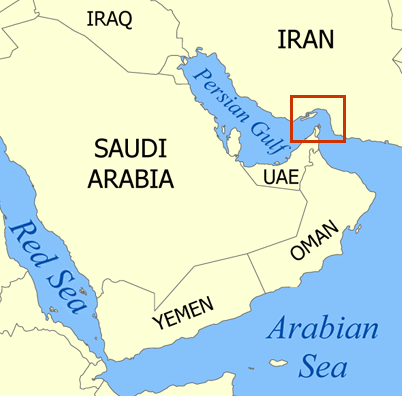
Why in news: On 5 October 2026, Saudi-backed forces of Yemen’s internationally recognised government said they had retaken Dhubab district, the coast around the Bab el-Mandeb Strait and the port city of Mocha (Mokha). The Houthis had seized these areas in an offensive launched on 3 September 2026. The Saudi-led coalition said 100 fighter jets were supporting the push, and the government also announced an offensive towards Sanaa, held by the Houthis since 2014. The Houthis denied losing Mocha.
Who is fighting whom
| Side | Backers | Holds |
|---|---|---|
| Presidential Leadership Council (PLC) government, led by Rashad al-Alimi | Saudi Arabia-led coalition | Aden (interim capital), south and east |
| Houthis (Ansar Allah), Zaydi Shia movement | Iran (“Axis of Resistance”) | Sanaa and the populous north-west |
Government units in the offensive include the Giants Brigades and the Nation’s Shield (Homeland Shield) Forces.
Why it matters for India
- Trade route: Bab el-Mandeb links the Red Sea to the Gulf of Aden and is the southern gateway to the Suez Canal. A large share of India’s trade with Europe, North Africa and the US East Coast passes through it.
- Costs: Houthi attacks on shipping since October 2023 forced ships around the Cape of Good Hope, raising freight and insurance costs for Indian exporters.
- Energy security: Oil and LNG flows from the Gulf to Europe and back rely on the strait.
- Diaspora and navy: India runs Operation Sankalp for maritime security in the region and evacuated citizens from Yemen in Operation Raahat (2015).
Key Facts for Prelims (Map)
| Fact | Detail |
|---|---|
| Meaning | “Gate of Grief” (Arabic) |
| Connects | Red Sea with Gulf of Aden and Arabian Sea |
| Countries on its shores | Yemen (Asia); Djibouti and Eritrea (Africa) |
| Width | About 26–32 km at the narrowest point |
| Island in the strait | Perim (Mayun) Island, belonging to Yemen |
| Nearby ports | Mocha (Yemen), Djibouti, Assab (Eritrea), Aden |
| Foreign bases in Djibouti | USA, China (first overseas base), France, Japan, Italy |
| Yemen capital | Sanaa (constitutional); Aden (interim seat of government) |
7. Centre Clears Elevation of Three High Court Chief Justices as Supreme Court Judges
Syllabus: GS2 – Judiciary, appointments
Why in news: On 5 October 2026, the Centre notified the appointment of three High Court Chief Justices to the Supreme Court, a week after the five-member Collegium headed by CJI Surya Kant recommended them on 28 September 2026. They take oath on 6 October 2026.
| Judge | Post held | Parent High Court |
|---|---|---|
| Justice Sunita Agarwal | Chief Justice, Gujarat HC (since July 2023) | Allahabad |
| Justice Devendra Kumar Upadhyaya | Chief Justice, Delhi HC | Allahabad |
| Justice Aparesh Kumar Singh | Chief Justice, Telangana HC | Jharkhand |
Significance: The number of women judges in the Supreme Court rises from two to three. Earlier in 2026 the Centre raised the sanctioned strength to 37 judges besides the CJI, so the new posts help cut pendency.
How a Supreme Court judge is appointed (Collegium system)
- Recommendation: The CJI and four senior-most judges (the Collegium) select names, considering seniority, merit and representation of High Courts.
- Background check: The Law Ministry gathers inputs, including from the Intelligence Bureau.
- Centre’s response: The government may return a name once for reconsideration; if the Collegium reiterates it, the name is binding.
- Appointment: The President issues the warrant under Article 124(2); the CJI administers the oath.
Debate on the Collegium
- For: Protects judicial independence, part of the basic structure.
- Against: Opaque, no written criteria, limited diversity; the government cannot speed or block it openly but can delay files.
- Reform: The NJAC (99th Amendment, 2014) was struck down in 2015; the Memorandum of Procedure (MoP) remains unsettled.
Key Facts for Prelims
| Fact | Detail |
|---|---|
| Article 124 | Establishment and constitution of the Supreme Court; appointment by the President |
| Article 217 | Appointment of High Court judges |
| Article 124(4) | Removal by Parliament on grounds of proved misbehaviour or incapacity |
| Retirement age | SC – 65 years; HC – 62 years |
| Three Judges Cases | 1981 (S.P. Gupta), 1993 (SC-AOR Association – Collegium created), 1998 (Presidential reference – 5-member Collegium) |
| Fourth Judges Case | 2015 – NJAC struck down |
| Parliament’s power | Article 124(1) lets Parliament fix the number of judges |
8. House Privileges vs Free Speech: The Question Before the Supreme Court
Syllabus: GS2 – Parliament and State Legislatures, Fundamental Rights
Why in news: A seven-judge Constitution Bench was set to hear, from 6 October 2026, whether legislative privileges under Article 194 can override the right to free speech under Article 19(1)(a). On 5 October, after Tamil Nadu said the 2003 Assembly resolution at the heart of the case had been withdrawn, CJI Surya Kant said the court would not engage in an academic exercise. The larger question may therefore wait for a live dispute.
Background of the case
- N. Ravi v. Speaker, Tamil Nadu Legislative Assembly (2003): The Assembly held that editorials and reports in The Hindu breached its privilege, sentenced journalists to jail and ordered arrests. The Supreme Court stayed the arrests in November 2003.
- The matter was referred to a larger Bench, and in October 2023 a seven-judge Bench agreed to hear it.
- Comedian Kunal Kamra, facing privilege proceedings in the Maharashtra Legislature, sought to intervene, arguing that privilege cannot be used to silence citizens.
The core questions
- Can privileges under Article 194(3) be used against non-members – journalists, comedians, citizens – for speech outside the House?
- Do uncodified privileges, inherited from the British House of Commons, sit above Articles 19(1)(a) and 21?
- Can a House act as judge in its own cause, and how far can courts review such action?
| Arguments for wide privilege | Arguments for free speech |
|---|---|
| Legislatures need to protect their dignity and functioning | Privileges exist to let the House work, not to shield members from criticism |
| Separation of powers; courts cannot examine House proceedings (Art. 212) | Uncodified, open-ended powers invite misuse against the press |
| Privileges are part of the Constitution itself (Art. 105/194) | Reasonable restrictions under Art. 19(2) already cover genuine contempt |
Key Facts for Prelims
| Fact | Detail |
|---|---|
| Article 105 | Powers and privileges of Parliament and its members |
| Article 194 | Powers and privileges of State Legislatures and their members |
| Article 194(3) | Other privileges as defined by law; until then, those existing before the 44th Amendment (1978) |
| Codification | No law yet codifies privileges in India |
| M.S.M. Sharma (Searchlight) case, 1959 | Privileges prevail over Article 19(1)(a) |
| Keshav Singh / Special Reference No. 1 of 1964 | Courts can review whether a privilege exists; Article 21 applies |
| Sita Soren v. Union of India, 2024 | Bribery by legislators is not protected by privilege |
| Who decides breach | Privileges Committee; Speaker/Chairman gives consent to raise the issue |
9. Why Is Buxa Bringing Tigers Back?
Syllabus: GS3 – Environment, Biodiversity conservation
Why in news: On 5 October 2026, Union Environment Minister Bhupender Yadav announced the release of tigress T138, translocated from Bihar’s Valmiki Tiger Reserve, into the wild at Buxa Tiger Reserve – West Bengal’s first tiger reintroduction. The plan is to bring about seven tigers to Buxa over two years.
Why Buxa lost its tigers
- The 2018 All India Tiger Estimation found no resident tigers in Buxa; a few had been recorded in 2012.
- Habitat fragmentation: The reserve is ringed by settlements, revenue villages and tea gardens, and crossed by roads and a railway line.
- Poor prey base: Grasslands shrank and herbivores such as chital declined, so tigers could not sustain territories.
- Past pressures included timber extraction, cattle grazing and poaching.
Why bring them back
- Apex predator: Tigers regulate herbivore numbers and keep the forest ecosystem healthy.
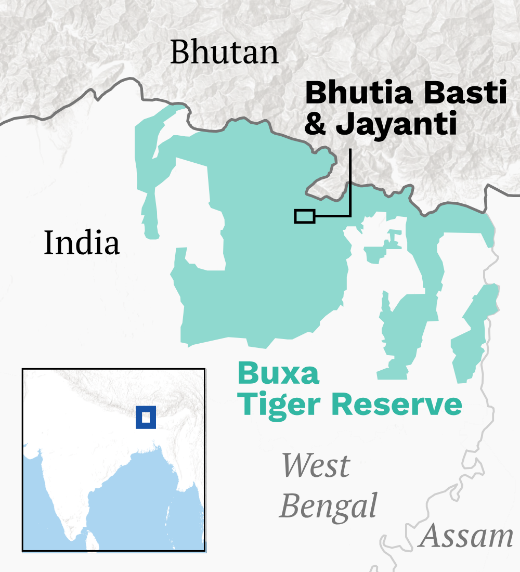
- Landscape link: Buxa connects with Phibsoo Wildlife Sanctuary (Bhutan) to the north and Manas (Assam) to the east, so a resident population can strengthen a trans-boundary tiger corridor.
- Source choice: Valmiki has similar hill-and-plain terrain and prey, making adaptation easier.
Conditions for success
- Prey first: Chital and sambar augmentation and grassland restoration before more releases.
- Breeding: Success means tigers establishing territories and raising cubs, not just the number released.
- Conflict control: With low wild prey, tigers may kill goats and cattle; quick compensation and community buy-in are vital.
- Genetic diversity: Natural movement through corridors must be kept open.
India’s past reintroductions show both outcomes – Sariska (2008) and Panna (2009) recovered after local extinction, while Satkosia (Odisha, 2018) failed amid local opposition.
Key Facts for Prelims
| Fact | Detail |
|---|---|
| Location | Alipurduar district, North Bengal, on the Bhutan border |
| Established | 1983, India’s 15th tiger reserve; area about 760 sq km |
| Neighbouring areas | Phibsoo WLS (Bhutan), Manas NP (Assam), Jaldapara NP |
| West Bengal’s tiger reserves | Sundarbans and Buxa |
| Source of tigress T138 | Valmiki Tiger Reserve, West Champaran, Bihar |
| Agencies | NTCA (statutory body under the Wildlife Protection Act, 1972, via 2006 amendment) and Wildlife Institute of India, Dehradun |
| Project Tiger | Launched 1 April 1973 |
| India’s tiger count | 3,682 (2022 estimation), about 75% of the world’s wild tigers |
| Tiger status | Endangered (IUCN); Schedule I, Wildlife Protection Act |
10. Why Are States Divided over the Mining Amendment?
Syllabus: GS3 – Mineral resources, Economy; GS2 – Fiscal federalism, Centre–State relations
Why in news: The Mines and Minerals (Development and Regulation) Amendment Act, 2026, passed by Lok Sabha on 12 August and Rajya Sabha on 13 August 2026, bars states from levying any tax or cess on mineral rights and mineral-bearing land except on conditions set by the Centre. Mineral-rich states see it as an attack on their taxing powers; the Centre and industry call it overdue rationalisation.
What the amendment does
- New Section 9D: States cannot impose levies based on mineral quantity, value, royalty or any other basis, except as the Centre prescribes.
- Mineral-bearing land is brought under central regulation alongside minerals.
- Past dues: Levies collected before the Act stay with states, but unpaid claims from before the Act cannot be enforced.
- Unchanged: States keep royalty, auction premium, DMF contributions and powers over minor minerals.
The trigger: the 2024 Supreme Court verdict
In Mineral Area Development Authority v. SAIL (July 2024), a nine-judge Bench held 8:1 that royalty is not a tax, and that states can tax mineral rights and mineral-bearing land under Entries 49 and 50 of the State List, subject to limits Parliament sets by law. The Court also allowed states to recover past dues from 2005. The 2026 amendment uses that “limits by Parliament” power under Entry 50.
| Centre and industry view | Mineral-rich states’ view |
|---|---|
| States levy about 14 different charges; costs vary sharply by state | States own the minerals; taxing them is a constitutional right affirmed by the SC |
| High levies raise power, steel and cement prices across India | Jharkhand, Odisha, Chhattisgarh and others depend heavily on mining revenue |
| Uniform taxes needed for critical minerals and energy security | The law overrides a nine-judge verdict through ordinary legislation |
| States’ royalty receipts have grown under auctions since 2015 (₹2.32 lakh crore) | Communities bear displacement and pollution while revenue is centralised |
Why states are divided: Producer states (Jharkhand, Odisha, Chhattisgarh, Karnataka) lose fiscal space, while consumer and industrial states gain from cheaper coal, steel and power. Opposition-ruled states may challenge the Act in court.
Key Facts for Prelims
| Fact | Detail |
|---|---|
| Parent law | MMDR Act, 1957 |
| Union List Entry 54 | Regulation of mines and mineral development under Union control |
| State List Entry 23 | Regulation of mines, subject to Entry 54 |
| State List Entry 49 / 50 | Taxes on lands and buildings / taxes on mineral rights, subject to limits by Parliament |
| Royalty fixed by | Central government (Second Schedule, MMDR Act); collected by states |
| Key case | Mineral Area Development Authority v. SAIL (2024): royalty is not a tax (8:1) |
| Earlier case overruled | India Cement Ltd v. State of Tamil Nadu (1989) |
| District Mineral Foundation | Created by the 2015 amendment for mining-affected areas |