Table of Contents
- Easy Money Over: RBI Hikes Repo Rate by 25 bps to 5.5% (GS3 – Economy)
- Up to 30% of Cotton Area Under Illegal GM Hybrids (GS3 – Agriculture, S&T)
- India Calls for De-escalation After Black Sea Vessel Attacks (GS2 – IR)
- "We Don't Distinguish Between Nations in Sea Operations": Coast Guard Chief (GS3 – Security)
- Living Planet Report 2026: Vertebrate Populations Down 73% in 52 Years (GS3 – Environment)
- I&B Ministry Notifies 13 Journalists as Press Council Members (GS2 – Polity)
- Rural Consumer Confidence Weakens for Six Straight Rounds: RBI Survey (GS3 – Economy)
- CEC Appointment Law: SC to Examine Plea for Recall of Sep 23 Split Verdict (GS2 – Polity)
1. Easy Money Over: RBI Hikes Repo Rate by 25 bps to 5.5%
Syllabus: GS Paper 3 – Indian Economy, Monetary Policy, Inflation
Why in News?
The Reserve Bank of India's Monetary Policy Committee (MPC) raised the policy repo rate by 25 basis points, from 5.25% to 5.50%, at the end of its 5–7 October 2026 meeting. This is the first rate hike since February 2023 and marks a clear end to the easing cycle of 2025, when the RBI had cut rates by a cumulative 125 bps.
What the RBI Decided
- Repo rate: raised to 5.50% (from 5.25%).
- Vote: unanimous decision of the six-member MPC headed by Governor Sanjay Malhotra.
- Stance: shifted from neutral to "calibrated tightening", keeping the door open for further hikes if price pressures intensify.
- FY27 GDP growth forecast: revised up to 7.1% (from 6.7%).
- FY27 CPI inflation projection: revised up to about 5.2%; core inflation projected at about 4.4%.
Why the RBI Tightened
- Imported inflation: crude oil prices above $100 a barrel amid the West Asia conflict.
- Weak rupee: the rupee slipped past 95 per US dollar, raising the cost of imports.
- Rising CPI: retail inflation climbed to 4.82% in August 2026 (from 4.45% in July), moving further above the 4% target, with forecasters expecting it to rise further in the coming months.
- Global tightening: several central banks, including the US Federal Reserve, have raised rates.
- Weak monsoon: the 2026 southwest monsoon ended at about 87% of the long-period average, adding to food-price risks.
What It Means for Borrowers and Savers
- Loans linked to the External Benchmark Lending Rate (EBLR) — most home loans since 2019 — re-price quickly, usually within a quarter.
- Rough estimate: each 25 bps hike adds around ₹800 a month to the EMI on a ₹50 lakh, 20-year home loan.
- Fixed deposit rates are likely to rise, benefiting savers and senior citizens.
Key Facts for Prelims
| Term | What it means |
|---|---|
| Repo rate | Rate at which the RBI lends short-term funds to banks against government securities |
| MPC | 6-member statutory body under Section 45ZB of the RBI Act, 1934 (inserted in 2016); 3 RBI members + 3 external members appointed by the Centre |
| Inflation target | 4% CPI, with a tolerance band of ±2% (flexible inflation targeting) |
| Basis point | 1 bps = 0.01 percentage point; 25 bps = 0.25% |
| SDF / MSF | Standing Deposit Facility (floor) and Marginal Standing Facility (ceiling) of the policy corridor |
| Last hike before this | February 2023 (to 6.50%) |
Mains angle: Discuss the trade-off between growth and price stability when inflation is driven by supply-side shocks (oil, currency) rather than excess demand.
2. Up to 30% of Cotton Area Under Illegal GM Hybrids, Finds Study
Syllabus: GS Paper 3 – Agriculture, Biotechnology, Science & Technology
Why in News?
A field study by the South Asia Biotechnology Centre (SABC), supported by the Federation of Seed Industry of India (FSII) and the National Seed Association of India (NSAI), estimates that unauthorised herbicide-tolerant Bt (HTBt) cotton was grown on 24–30% of India's cotton area in Kharif 2025-26.
Key Findings of the Study
- Area: an estimated 65–72 lakh acres (about 26–29 lakh hectares) under illegal HTBt cotton.
- Black market: an informal seed market worth about ₹1,500 crore.
- Coverage: 16 districts across Maharashtra, Telangana, Andhra Pradesh and Rajasthan, using farmer surveys, supply-chain mapping and ELISA-based gene testing.
- Lab results: 98.2% of field samples carried at least one GM trait; the herbicide-tolerance gene was found in about 73% of samples; nearly 42% contained four transgenes, including Vip3A, an insect-resistance gene not approved in India.
- Economics driving adoption: weed control with glyphosate costs roughly ₹750–850 per acre, compared with ₹12,000–15,000 for manual weeding.
- Glyphosate use rose about 26% in a year, from 27,721 kilolitres (2024-25) to 35,642 kilolitres (2025-26).
Why It Matters
- Regulatory failure: farmers are adopting unapproved technology at scale while applications remain pending with the regulator.
- Biosafety risks: unknown and untested traits can contaminate legal seed stocks and enter the food chain through cottonseed oil.
- Farmer risk: no quality guarantee, no compensation if illegal seeds fail.
- Seed industry demand: FSII and NSAI have asked the government to approve HTBt cotton and review glyphosate label claims.
Key Facts for Prelims
| Fact | Detail |
|---|---|
| Only GM crop approved for commercial cultivation in India | Bt cotton (approved 2002) |
| Approved Bt genes | cry1Ac and cry2Ab (Bollgard-II), from the soil bacterium Bacillus thuringiensis |
| HTBt cotton | Bt cotton + tolerance to the herbicide glyphosate |
| Regulator | Genetic Engineering Appraisal Committee (GEAC), under the MoEFCC |
| Legal framework | Environment (Protection) Act, 1986 and the Rules, 1989 on hazardous microorganisms and GE organisms |
| Pest concern | Pink bollworm resistance to Bt cotton |
Mains angle: "Illegal HTBt cotton is a symptom of regulatory inertia in agricultural biotechnology." Critically examine.
3. India Calls for De-escalation After Black Sea Vessel Attacks
Syllabus: GS Paper 2 – International Relations, India's Diaspora; GS Paper 3 – Maritime Security
Why in News?
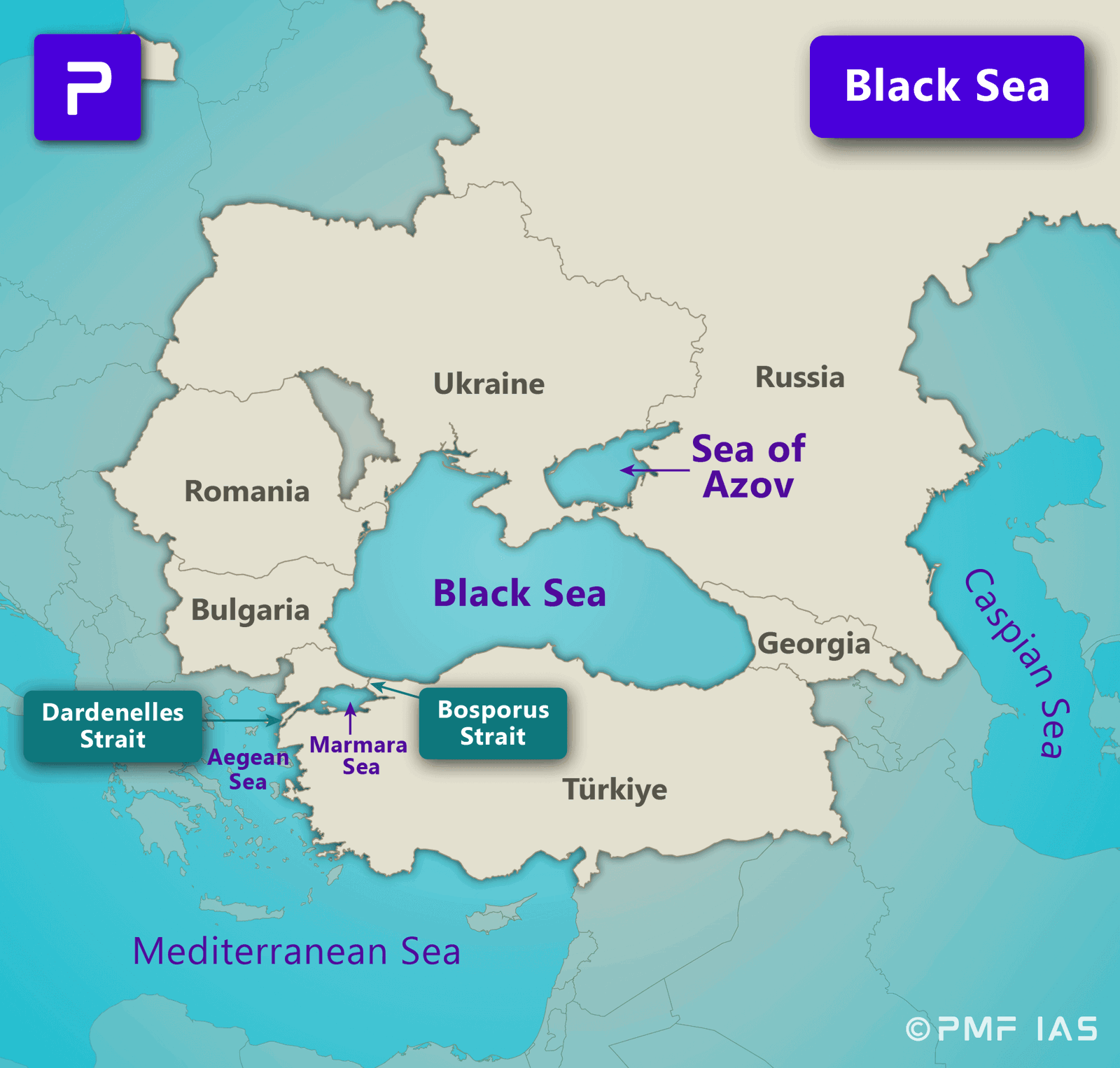
The Ministry of External Affairs (MEA) condemned a string of attacks on four commercial vessels in the Black Sea over two days, in which two of the 33 Indian nationals on board were injured. India called for de-escalation, dialogue and diplomacy to end the Russia–Ukraine conflict.
What Happened
- MV Royad Mammadov, a Turkish-owned grain ship, was struck and sank on 5 October; two foreign seafarers, including the captain, were killed. Its three Indian crew were rescued by Romanian authorities; one is being treated at Constanța.
- In another incident, all 23 Indian seafarers on a vessel that came under attack were rescued.
- MEA spokesperson Randhir Jaiswal said India is engaging both Russia and Ukraine to help bring peace.
Background
- At least five Indian seafarers have been killed in Black Sea attacks since April 2026 (including four aboard MV Golden Leo off Odesa in July).
- India has summoned envoys of both Russia and Ukraine, signalling an even-handed stand.
- DG Shipping and the MEA issued advisories asking seafarers to assess risks before taking jobs on vessels in the region.
- In September 2026, India and Liberia launched a 25-nation "Group of Friends on Safety and Security of Shipping and Seafarers" at the UN General Assembly.
- Ukraine has said it received ceasefire proposals from India, the US, Turkey and Egypt.
Key Facts for Prelims
| Fact | Detail |
|---|---|
| Black Sea bordering countries | Ukraine, Russia, Georgia, Türkiye, Bulgaria, Romania |
| Straits linking it to the Mediterranean | Bosphorus → Sea of Marmara → Dardanelles |
| Treaty governing passage | Montreux Convention, 1936 |
| Black Sea Grain Initiative | UN–Türkiye brokered deal (July 2022); Russia withdrew in July 2023 |
| India's seafarers | Over 3.2 lakh active seafarers (2025) — among the world's top suppliers |
Mains angle: How should India protect its seafarers while maintaining strategic autonomy between Russia and the West?
4. "We Don't Distinguish Between Nations in Sea Operations": Coast Guard Chief
Syllabus: GS Paper 3 – Security Challenges in Border/Maritime Areas; GS Paper 2 – Regional Cooperation
Why in News?
Indian Coast Guard (ICG) Director General Paramesh Sivamani underlined that India's maritime search and rescue (SAR) effort does not discriminate by the nationality of a ship or its crew. His remarks came at the 24th National Maritime Search and Rescue (NMSAR) Board meeting in Bhubaneswar and the SAREX-2026 exercise off Paradip, Odisha.
SAREX-2026 at a Glance
- 12th National Maritime SAR Exercise, inaugurated on 7 October by Minister of State for Defence Sanjay Seth; sea phase off Paradip on 8 October.
- 32 observers from 30 countries took part.
- Scenario: a mass rescue operation — a passenger aircraft with 228 people ditching at sea and colliding with a container vessel.
- Assets: 15 ICG ships, 2 Dornier aircraft, 3 ALH and 1 Chetak helicopter, IAF C-130J and Mi-17 aircraft, and 2 Indian Navy ships.
- The DG called the new MEO LUT satellite ground station a "game changer" for detecting distress signals faster.
Why It Matters
- Humanitarian SAR regardless of flag reflects India's obligations under the SOLAS and SAR (1979) conventions.
- It builds India's image as a first responder and net security provider in the Indian Ocean, in line with SAGAR and MAHASAGAR.
- Shortly before the exercise, the ICG assisted a flooding Belize-flagged tanker off Paradip — an example of flag-neutral rescue.
Key Facts for Prelims
| Fact | Detail |
|---|---|
| ICG established | 1977 (interim); Coast Guard Act, 1978; under the Ministry of Defence |
| National Maritime SAR Coordinating Authority | DG, Indian Coast Guard |
| SAR network | 3 Maritime Rescue Coordination Centres (Mumbai, Chennai, Port Blair) and 36 sub-centres |
| Current DG | Paramesh Sivamani (26th DG, since October 2024) |
| MAHASAGAR | Mutual and Holistic Advancement for Security and Growth Across Regions (2025) |
5. Living Planet Report 2026: Average Size of Vertebrate Populations Declined 73% in 52 Years
Syllabus: GS Paper 3 – Environment, Biodiversity & Conservation
Why in News?
WWF's Living Planet Report (LPR) 2026, released on 8 October, shows a 73% average decline in the size of monitored wildlife populations between 1970 and 2022 — a span of 52 years.
Key Findings
- Based on the Living Planet Index (LPI) compiled by the Zoological Society of London (ZSL).
- Covers 35,803 populations of 5,790 vertebrate species — mammals, birds, amphibians, reptiles and fish.
- Equivalent to an average decline of roughly 2.5% per year.
- Freshwater populations show the steepest fall (about 85%).
- Main threats: habitat loss and degradation (largely driven by the food system), overexploitation, climate change, pollution, invasive species and disease.
- Theme of hope: the report highlights recoveries such as tigers, bluefin tuna and green turtles, and argues for "positive tipping points" in food, energy and finance systems. India's tiger recovery is cited as an encouraging example.
Important Clarification (Often Asked)
The 73% figure is not the share of animals lost. It measures the average proportional change in population size across monitored populations. Some populations are increasing; the size of the declines outweighs the gains.
Key Facts for Prelims
| Fact | Detail |
|---|---|
| Publisher | WWF (biennial); LPI by ZSL |
| Edition | 16th edition (first published 1998) |
| Earlier figures | 69% decline (LPR 2022, data to 2018); 73% (LPR 2024, data to 2020) |
| 2024 regional trend | Latin America & Caribbean worst hit (~95%), Africa (~76%), Asia-Pacific (~60%) |
| Global target link | Kunming-Montreal GBF — protect 30% of land and sea by 2030 ("30x30") |
Mains angle: "Biodiversity loss is a systems problem, not a species problem." Discuss with reference to the LPR 2026.
6. I&B Ministry Notifies Names of 13 Journalists as Press Council Members
Syllabus: GS Paper 2 – Statutory Bodies, Freedom of Press, Media Regulation
Why in News?
The Ministry of Information and Broadcasting issued a notification on 7 October 2026 nominating 13 working journalists to the Press Council of India (PCI) — six editors and seven working journalists other than editors. The PCI had been functioning at roughly half strength for nearly a year without any working journalist or editor.
Who Was Nominated
- Editors (6): Pradeep Kumar Jain, Sayed Raza Husain Rizvi, Ankur Dua, Aparna Shukla, Raj Parwana/Narender Singh, Vinod Bajpai.
- Working journalists other than editors (7): Vinod Kohli, Geetartha Pathak, Prajnananda Chaudhuri, Kingshuk Pramanik, C.K. Nayak, Prasanna Kumar Mohanty, Bijoy Kakchingtabam.
- Chairperson: Justice Ranjana Prakash Desai (retd.).
- Existing members (14): 5 MPs, 6 representatives of newspaper owners, and 3 experts nominated by the UGC, Bar Council of India and Sahitya Akademi.
Why It Matters
The delay in completing the 15th term (the 14th term ended in October 2024) had left the media watchdog without journalist representation, weakening its role in hearing complaints and protecting press freedom.
Key Facts for Prelims
| Fact | Detail |
|---|---|
| First set up | 1966, under the Press Council Act, 1965 |
| Current law | Press Council Act, 1978 |
| Nature | Statutory, quasi-judicial body |
| Composition | Chairperson + 28 members |
| Working journalists | 13 (6 editors + 7 others) |
| MPs | 5 (3 from Lok Sabha, 2 from Rajya Sabha) |
| Chairperson selected by | Committee of Rajya Sabha Chairman, Lok Sabha Speaker and a PCI member |
| Jurisdiction | Print media and news agencies only (not TV or digital) |
| National Press Day | 16 November (PCI's founding day) |
7. Rural Consumer Confidence Weakens for Six Straight Months: RBI Survey
Syllabus: GS Paper 3 – Indian Economy, Consumption, Rural Economy
Why in News?
The RBI's September 2026 round of its bi-monthly consumer confidence surveys shows rural households' assessment of the current economy falling for the sixth consecutive survey round.
Key Findings
- Rural Current Situation Index (CSI): fell to 90.6 in September from 91.7 in July — deeper into the pessimistic zone.
- Urban CSI: slipped to 87.9 (from 88.3); the urban Future Expectations Index (FEI) fell to 113.5 (from 115.3) but remains optimistic.
- 54.5% of urban respondents said the general economic situation had worsened over the past year.
- Households' median year-ahead inflation expectation rose to about 10%.
- Concerns centre on prices and employment.
Why It Matters
- Rural demand drives FMCG, two-wheeler and tractor sales; prolonged pessimism can slow consumption-led growth.
- Rising household inflation expectations strengthen the RBI's case for tightening — linking this story directly to the repo rate hike above.
- Weak monsoon and high food prices add to rural stress.
Key Facts for Prelims
| Fact | Detail |
|---|---|
| Surveys | Rural Consumer Confidence Survey (RCCS) and Urban Consumer Confidence Survey (UCCS) |
| Frequency | Bi-monthly |
| CSI | Current perceptions compared with a year ago |
| FEI | Expectations for one year ahead |
| Reading the index | Above 100 = optimism; below 100 = pessimism |
| Parameters | Economic situation, employment, prices, income, spending |
8. CEC Appointment Law: SC to Examine Requests to Hear Plea for Recall of Sep 23 Split Verdict
Syllabus: GS Paper 2 – Constitutional Bodies, Judiciary, Electoral Reforms
Why in News?
A Bench headed by Chief Justice of India Surya Kant (with Justices Joymalya Bagchi and V. Mohana) agreed to examine an application seeking recall of the 23 September split verdict on challenges to the Chief Election Commissioner and Other Election Commissioners (Appointment, Conditions of Service and Term of Office) Act, 2023. Senior advocate Gopal Sankaranarayanan mentioned the plea; the CJI said the court would examine it and take a call.
The 23 September Split Verdict
- A two-judge Bench of Justices Dipankar Datta and Satish Chandra Sharma differed on whether the challenge should go to a larger Constitution Bench.
- Justice Datta rejected the Centre's request for a reference; Justice Sharma favoured it.
- Both directed that the matter be placed before the CJI to constitute a Bench of appropriate strength.
The Recall and Curative Pleas
- A separate curative petition by petitioner Jaya Thakur argues that Justice Sharma's son has been a standing counsel for the Election Commission before the Madhya Pradesh High Court since July 2024, raising a reasonable apprehension of bias.
- It relies on the Supreme Court's "real danger" and "reasonable likelihood of bias" tests and the principle that justice must be seen to be done.
Background
- Article 324 empowers the President to appoint the CEC and ECs, subject to any law made by Parliament.
- In Anoop Baranwal v. Union of India (March 2023), a Constitution Bench ordered a selection panel of the PM, Leader of Opposition and CJI until Parliament enacted a law.
- The 2023 Act replaced the CJI with a Union Cabinet Minister nominated by the PM, raising concerns about the Election Commission's independence.
Key Facts for Prelims
| Fact | Detail |
|---|---|
| Constitutional provision | Article 324 |
| Selection committee (2023 Act) | PM (chair), Leader of Opposition/largest opposition party leader in Lok Sabha, Union Cabinet Minister |
| Curative petition | Evolved in Rupa Ashok Hurra v. Ashok Hurra (2002) |
| Curative petition Bench | Three senior-most judges + judges of the original Bench (if available) |
| Review petition | Article 137 |
| Legal maxim | Nemo judex in causa sua — no one should be a judge in their own cause |